
Right Under Our Noses: The Scents of Pasar Geylang Serai
Pasar Geylang Serai. A place and a memory that feels both real and fantastical to me.
The Real
Real, because I know my grandmother, my father and my mother go there frequently to get really important meat, seafood and produce. Ahma only gets her coconut milk from there for her laksa nyonya. She gets really good dried keropok from there too, which she fries up perfectly, even though this means the kitchen floor needs extra mopping on keropok days. Lea won't eat keropok from anywhere else, because Mama Cho's keropok is the best.
On marketing day, my father wakes up at 4am to get the earliest catch - he's a firm favourite because he buys enough to feed an army: 30kg of prawns, 20kg of squid and 30kg of fish is a typical day for him. When his fishmonger sees him coming, they know they'll get to go home early that day. He likes living large, and the stall owners would like to keep it that way.
My mother's sotong hitam, with each squid bursting with roe, is only possible because her squid supplier sets aside the biggest ones for her. And anyone who knows sambal goreng pengantin will know that beef lung - paru, in Malay, a quintessential ingredient in that dish - must only be procured from Pasar Geylang.
The Fantastical
Needless to say, my family and I have had our bellies fed by the bounty Pasar Geylang provides.
But the truth is, I've never once followed them to the market. I've only been there myself a handful of times, as a young adult, and even then I stayed within the confines of the clothes and cooked food section. Downstairs felt like too much - too busy, and honestly (and I feel the guilt typing this out) the thought of wading through slippery floors while being assaulted by fishy smells was more than I could handle back then. I'm a lot more acquainted with the act of (wet) marketing now, but even so, I've noticed how I still hold my breath walking past the fish and meat sections.
Do I really know Pasar Geylang? I know it only through the very real experience of eating food my family cooks, and through my dad's generous seafood contributions to our freezer at home. The wet market of Pasar Geylang is still a fantastical place to me - I've never known it fully, yet I know of it the way I know of real yet mythical creatures like the komodo dragon or the narwhal.
Rakyat Archive's Scent Storytelling
So when Jen asked if I'd like to go for Rakyat Archive's Scent Storytelling with Aroma Nostalgia and Sendok Rakyat, I said yes immediately. I wanted to experience Pasar Geylang the way my family does, on marketing days.
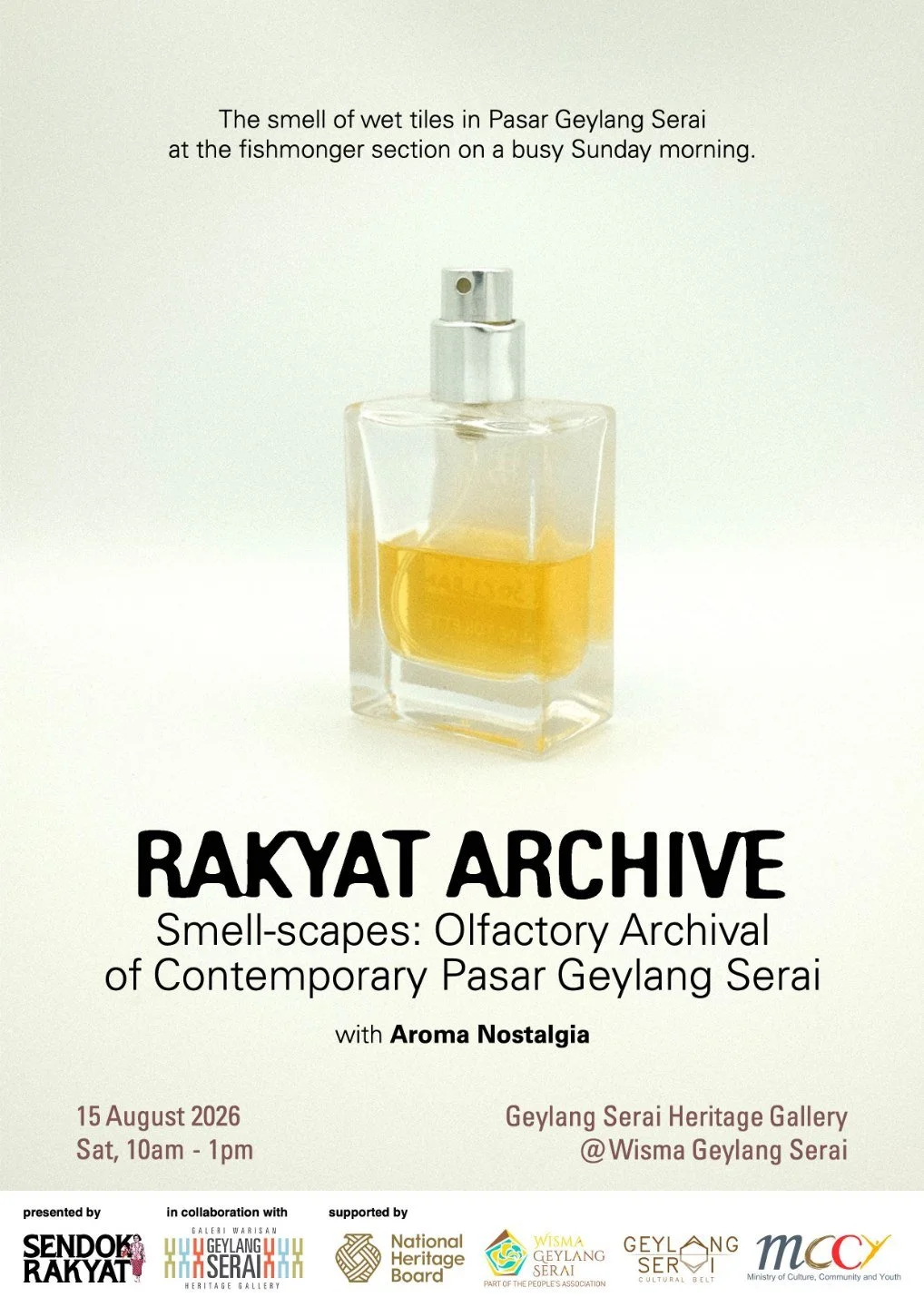
Event Poster for Rakyat Archive: Smell-scapes: Olfactory Archival of Contemporary Pasar Geylang Serai
When Nora from Aroma Nostalgia spoke about how scent gets sorted into pleasant and unpleasant - with Asian wet market smells almost always filed under unpleasant - I felt a pang of guilt. As a child, I remember hating going to the wet market because my dad would drag us there. Those visits were made bearable by tau huay (soybean pudding) and you tiao (dough fritters), the breakfast reward for putting up with the smell of fish and chicken. I remember, too, on our trips to Australia, wishing wet markets here could be as clean as theirs - air-conditioned, even. Decolonising smell is such a powerful act of reclaiming your identity, Nora shares, recounting her own childhood growing up in Tanjung Pinang. By the end of her sharing, my mind was open, and I was ready to unlearn.
Walking Through Pasar Geylang
We entered Pasar Geylang through the fish and seafood section, and it hit me almost immediately. Fresh cockles, still caked in mud - dug up that morning, the fishmonger says, proudly. Fish glistening against trays of ice. I smell the ice before I smell the fish. Funny, that. The famous Geylang squid, piled up like amethyst gems - slippery, I think, the squid smells slippery. Is that even a smell? Can something smell like a texture? I don't know, but that's what comes to mind, so I let it stay.
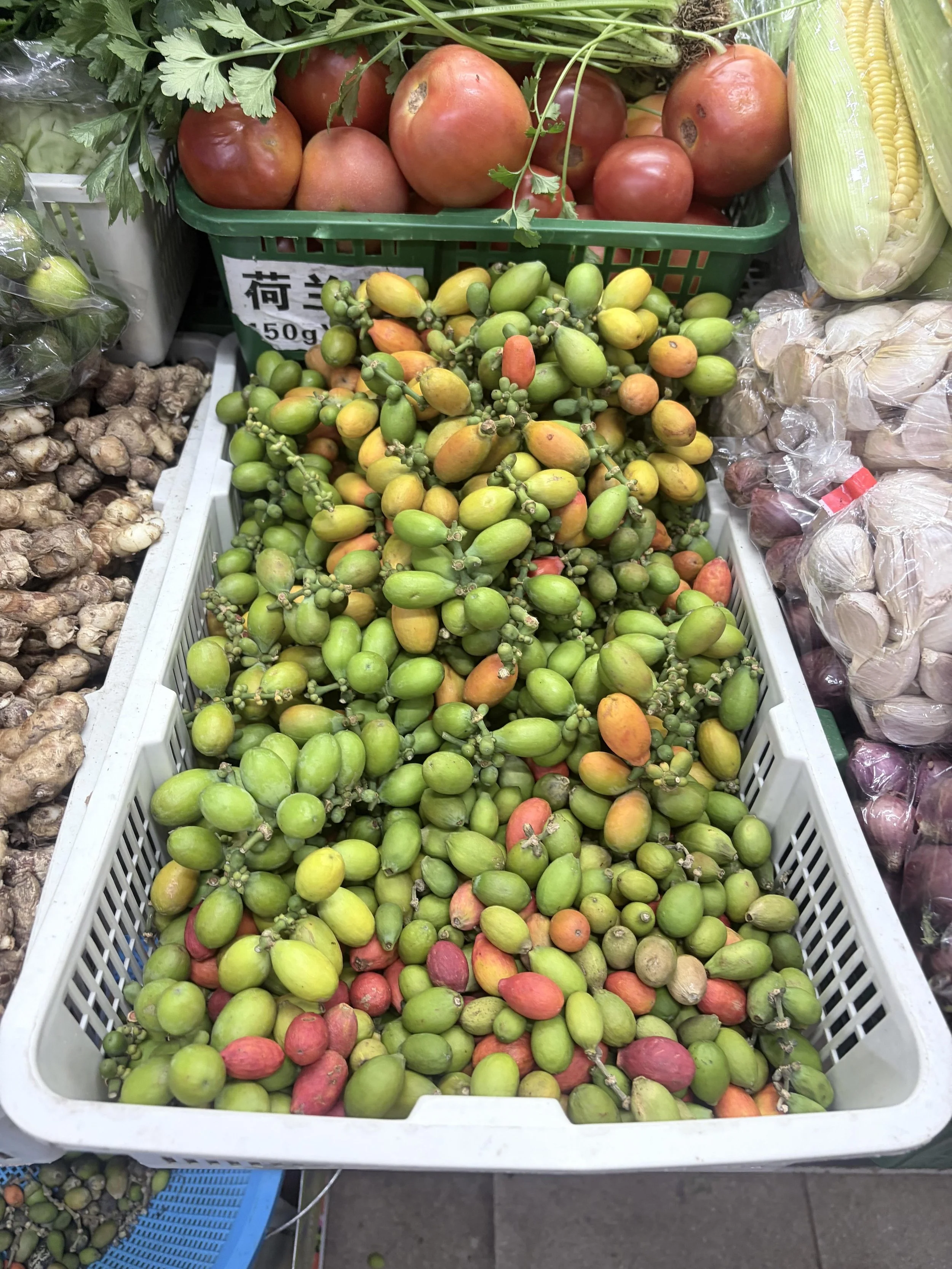
Belinjau fruit, as in the main star in Keropok Belinjau!
Then vegetables and fruit. Serai - lemongrass - everywhere, and the smelly bean, petai, right behind it. I've never once found petai pungent - something I’m very proud of. Ginger in every variety you can imagine - old, new, yellow, orange. Bananas of all sizes and those huge purple flowers we always call Pontianak flowers, half-joking, half-not. At one stall I ask what this unfamiliar fruit is. Belinjau, the kind-faced seller says. How embarrassing, that I didn't know! I've eaten keropok belinjau my whole life and never once seen the fruit it comes from! She has beautiful ginger flowers too, from Malaysia, the kind that go into rojak and assam pedas. I buy two, already hungry.
We have just enough time to head upstairs for the cooked food section, and I spot one of my favourite kueh and make a dash for it - badak berendam, little green glutinous rice gems with gula melaka soaked coconut - enrobed in a thick coconut gravy. The makcik tells me it's like Japanese mochi. I laugh. I don't need the comparison - mochi is more foreign to me than this kueh ever was - but I understand why she reaches for that association for me. Jen buys some impossibly good grilled tapioca kueh, and then it's time to go. We spent the rest of the afternoon making our own perfume, built from the scents we'd carried out of the pasar. It was so fun getting to layer one scent on top of another. The smell of wet tiles? Black Pepper? Wooden furniture? Pandan? Earthy soil? Yes to all of that.
Right Under Our Noses
Delicious kueh and multi-layered scents aside, this, I think, is what lingered with me the longest, long after the perfume faded away: decolonisation can sound like homework - grand theories to sit with, entire systems of governance, language, education, identity, to take apart and rebuild. It's easy to feel like you need a reading list and a workshop before you're even allowed to start. But walking through Pasar Geylang that afternoon, I realised decolonising smell asks for none of that. It asks only that the next time I catch the scent of fish and mud and ice, I notice which reflex shows up first - disgust, or curiosity - and choose, on purpose, to stay a beat longer and ask myself why and where my response comes from. That's it. That's the whole practice. We don't always have to work through the grand theories to begin unlearning. Sometimes the greatest act of decolonisation is right there under our noses.
It was such an unlearning, in the best way, and I'm already looking forward to whatever Sendok Rakyat and Aroma Nostalgia do next. I'm already planning another trip back to the pasar - with my dad this time (but perhaps not at 4am).
Here's to Pasar Geylang Serai - may she continue to stand where she is, unchanged by time and untouched by our government's never-ending pursuit of development.
